

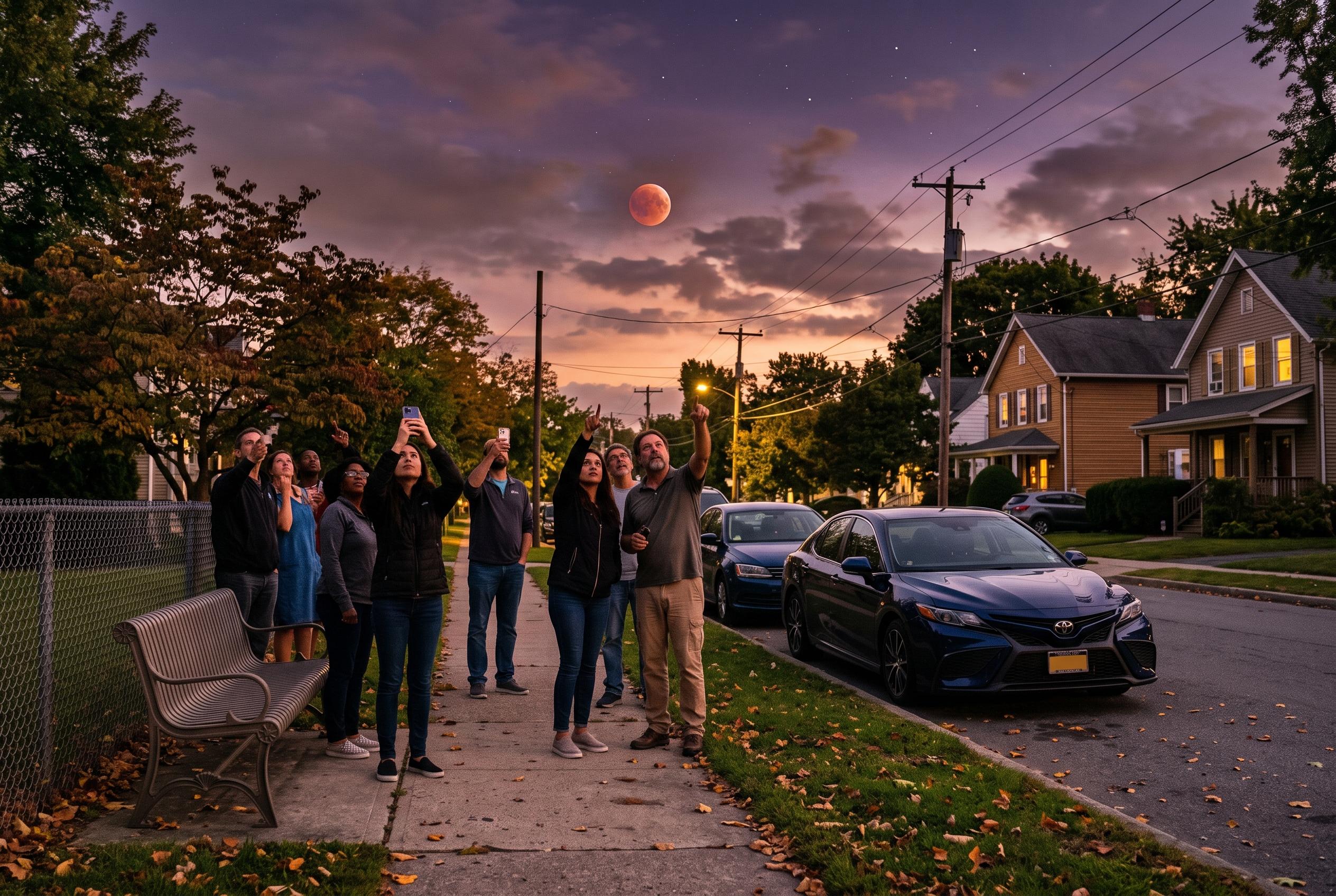

The August full moon, known as the Sturgeon Moon, will coincide with a rare lunar eclipse visible across the Americas, Africa and Europe on 28 August 2026, offering a spectacular celestial show.
The August full moon will reach its peak at 12.18 a.m. on 28 August 2026, and the event is set to coincide with a lunar eclipse that should be visible across the Americas, and parts of Africa and Europe, as Earth moves between the sun and moon. Space.com says observers in the western United States will see the shadow already creeping across the lunar surface at moonrise on 27 August, while viewers on the east coast will have to wait a little longer for the eclipse to begin. The result, at maximum, could be a deeply shaded moon with only a bright rim still catching the light. The timing and visibility details are also reflected in astronomy tables published by Time and Date.
August’s full moon is widely known as the Sturgeon Moon, a name that The Old Farmer’s Almanac traces to the season when sturgeon were more easily caught in the Great Lakes and Lake Champlain. The same Almanac notes that other traditional names for the moon include the Flying Up Moon among Cree communities, while Corn Moon, Harvest Moon and Ricing Moon are also used in different cultural and agricultural contexts.
For sky-watchers in the US, the moon should rise over the eastern horizon at sunset on 27 August, and Space.com notes that it may take on a yellow-orange tint shortly after moonrise as atmospheric scattering filters out shorter wavelengths. It may also appear larger when it is low in the sky, thanks to the well-known Moon Illusion. Time and Date gives local full-moon timings for cities including New York, London, Beijing, Tokyo and Sydney, underlining how the exact moment of full illumination is the same globally even though local observing conditions vary.
The eclipse should be especially striking for viewers in Europe and Africa in the early hours of 28 August, when Space.com says up to 96% of the lunar disc could be swallowed by Earth’s inner shadow at maximum. That would leave the moon glowing an intense red, the familiar effect produced when sunlight is refracted through Earth’s atmosphere. The lunar spectacle also lands on Raksha Bandhan, the Hindu festival that celebrates the bond between brothers and sisters.
The moon will not be the only target in the night sky. Space.com says the Summer Triangle, formed by Vega, Deneb and Altair, will still be visible despite the glare of the full moon, while Venus should hang low in the west and Saturn will rise later in the evening. In the pre-dawn hours of 28 August, Jupiter and Mars will be visible together in the eastern sky, with Orion nearby as an early reminder of the constellations that dominate the winter months. For those hoping to photograph the event, a stable tripod, a remote shutter and a long lens are among the practical suggestions commonly recommended by astronomy guides.
Disclaimer: This content is intended for informational purposes only. Readers are advised to exercise their own judgement, conduct due diligence, or consult a qualified expert before acting on any information provided.