

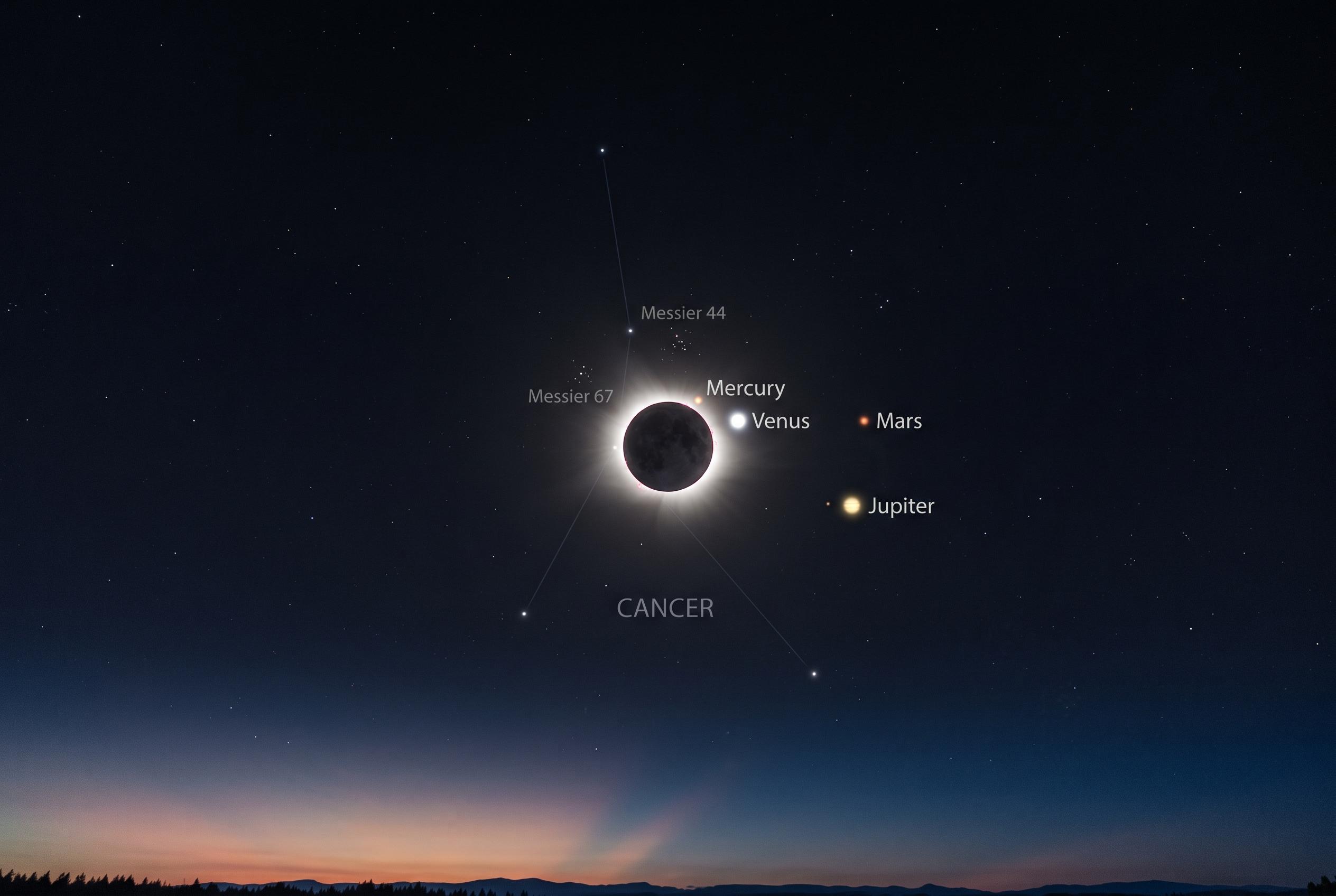

The 12 August 2026 total solar eclipse, featuring a rare alignment with four planets in Cancer, promises a celestial spectacle that captivates both astronomers and astrologers, with visibility spanning across parts of Europe, North America, and beyond.
A total solar eclipse is due on 12 August 2026, and astrologically minded readers are already treating it as one of the year’s more notable sky events. According to Aaj Tak, the eclipse falls in Cancer and arrives alongside a rare four-planet alignment, with the Sun, Moon, Mercury and Jupiter all gathered in the same sign. For people following the celestial symbolism, that combination gives the event an extra layer of interest.
The eclipse is expected to run from 9:04 pm to 1:27 am, with its peak between 10:28 pm and 12:04 am, and the most dramatic total phase around 11:16 pm, Aaj Tak reported. The paper said the effect will only be visible in parts of the world, including Greenland, Iceland, Spain, Russia, much of Europe, sections of North Africa, parts of North America, the Atlantic Ocean region and the Arctic.
For viewers in India, the practical takeaway is simple: the eclipse will not be visible there, so the customary Sutak period is not considered applicable. That point is also echoed by several astronomy and astrology explainer sites, which note that the 12-hour pre-eclipse restrictions are only observed where the eclipse can actually be seen. In other words, the spiritual rules often discussed around eclipses do not carry over automatically to every location.
Even so, the usual safety advice still matters for anyone observing the event from the eclipse path. The sources recommend avoiding direct viewing without a proper solar filter, while also suggesting familiar spiritual practices such as meditation, chanting the Gayatri mantra, bathing after the eclipse and giving to those in need. For those who like to treat eclipses as both a spectacle and a moment to pause, this one looks set to offer a striking mix of astronomy, tradition and a little cosmic theatre.
Disclaimer: This content is intended for informational purposes only. Readers are advised to exercise their own judgement, conduct due diligence, or consult a qualified expert before acting on any information provided.