
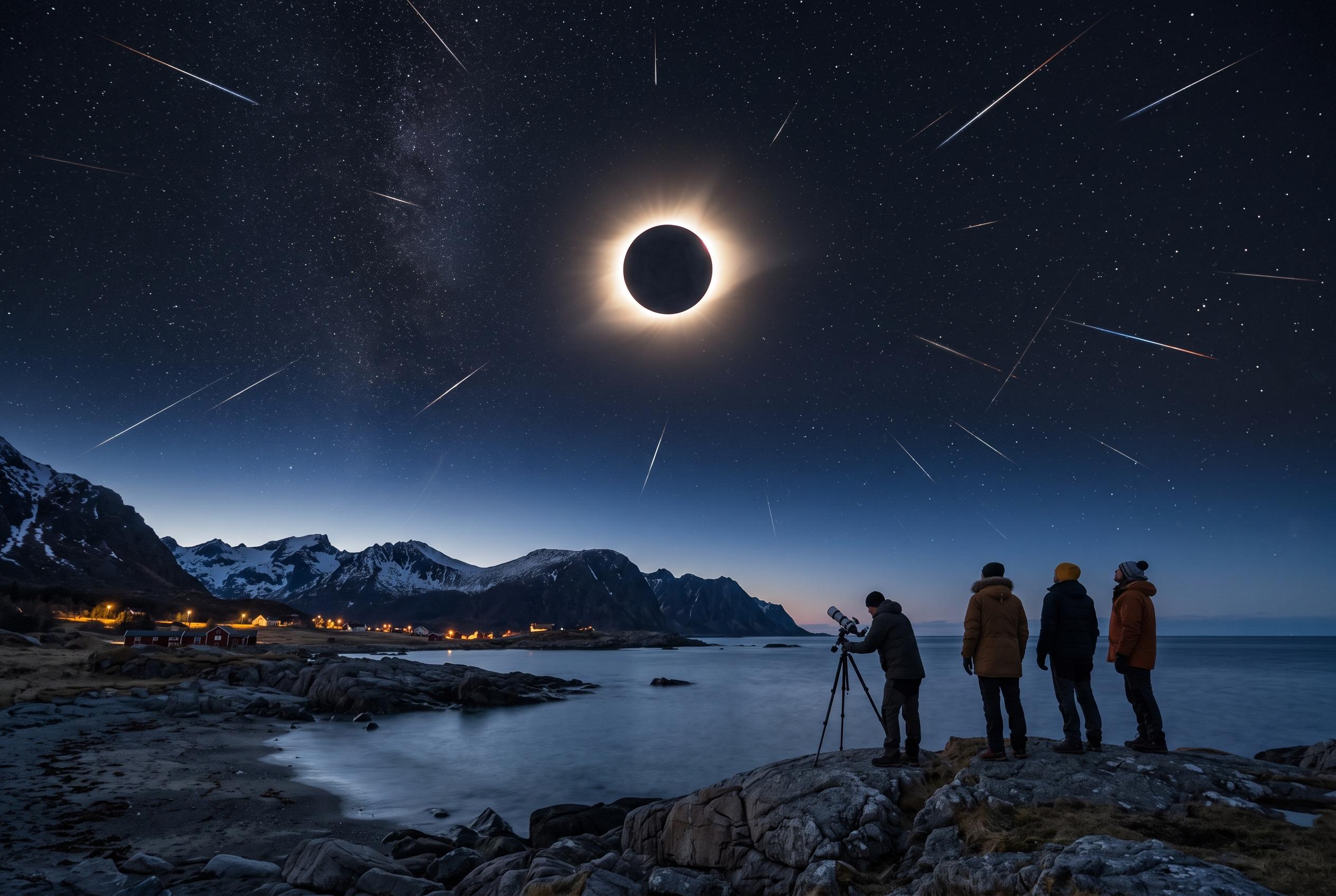

On 12 August, a rare total solar eclipse will be visible across parts of Europe and the Arctic, coinciding with the Perseid meteor shower for a spectacular night sky show.
A total solar eclipse will sweep across the Northern Hemisphere on 12 August, with the most dramatic views reserved for a narrow track stretching over the Arctic Ocean, Greenland, Iceland, Spain and a sliver of northern Portugal. In much of Europe, including the UK and Ireland, skywatchers will still get a striking partial eclipse, with the Moon taking a substantial bite out of the Sun. In north-west Bulgaria, the event will be visible only briefly as the Sun approaches the horizon.
Astronomers say the timing makes this one especially appealing: it is the first total solar eclipse visible from mainland Europe since 1999, and in Spain it will unfold close to sunset, creating the kind of low-light, golden-hour drama eclipse chasers love. Cities including Bilbao, Santander, Valladolid, Burgos, Zaragoza, Valencia and Palma are expected to fall within the path of totality, while Madrid and Barcelona will see a near-total partial eclipse. In Portugal, the best odds for the full effect appear to be in the north-east, near the Spanish border.
The event is arriving with a useful bonus for anyone willing to stay outside after dark: the Perseid meteor shower is set to peak the same night. Timeanddate.com says the shower should offer one of the year’s best displays under a new moon, while other astronomy guides are encouraging viewers to find a dark, open spot with a clear western horizon if they want to make a full evening of it. That combination of eclipse and meteors gives August 12 a rare “double feature” feel.
Safety still matters, though. Experts quoted by The Guardian stress that eclipse glasses or proper solar filters should be used whenever the Sun is not fully covered, and only removed during totality itself. ESA says the eclipse will also be a chance to study the Sun’s corona, the outer atmosphere that becomes visible only when the bright solar disc is blocked. For travellers, Spain looks like the easiest place to chase the full experience; for everyone else, a deep partial eclipse and a summer night sky show should still make for a memorable evening.
Disclaimer: This content is intended for informational purposes only. Readers are advised to exercise their own judgement, conduct due diligence, or consult a qualified expert before acting on any information provided.