

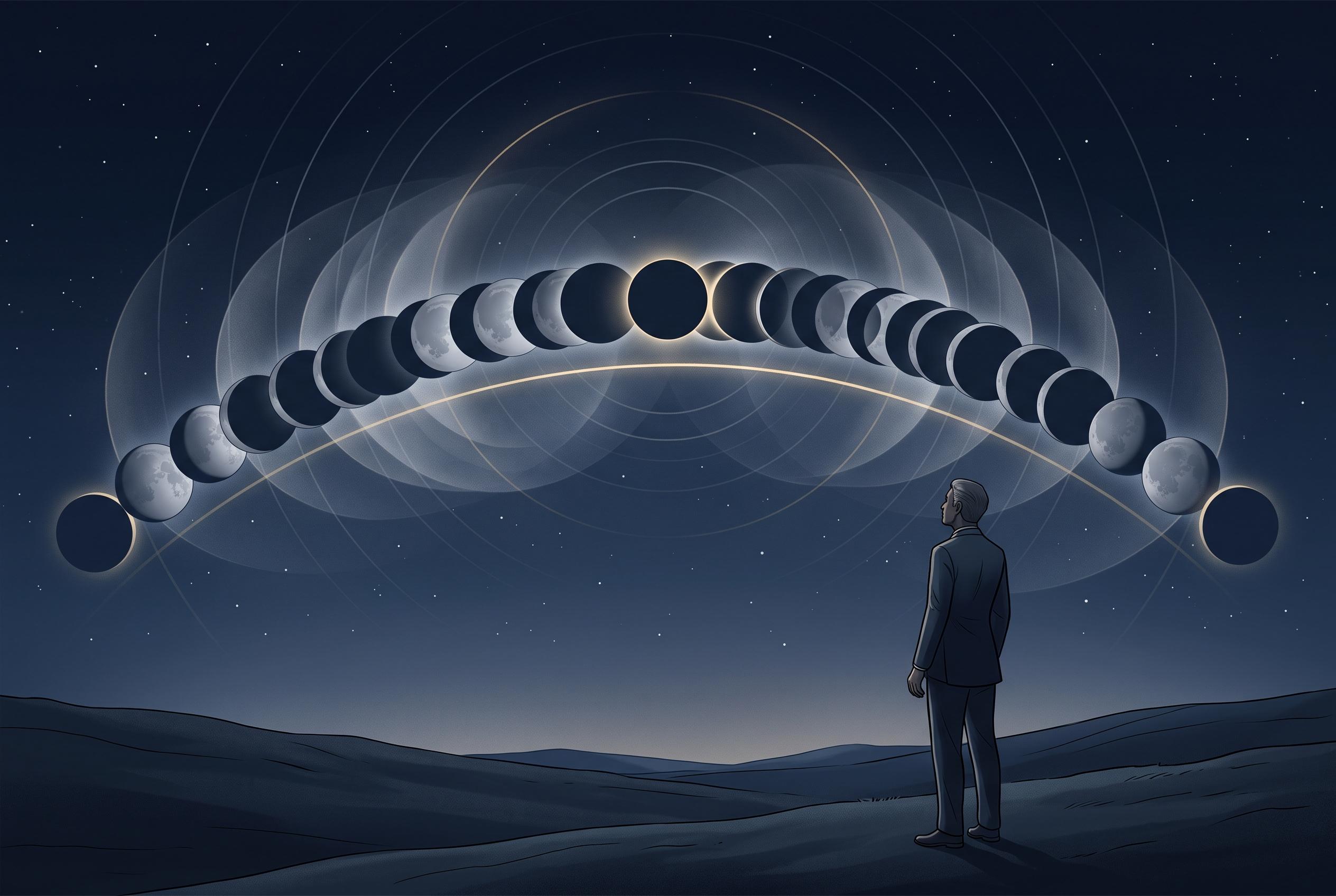

Eclipse season, spanning roughly 35 days twice a year, is more than a spectacle, it reflects deeper astronomical cycles and astrological patterns that emphasize timing, recurring themes, and long-term echoes across history and personal change.
Eclipse season has a way of feeling bigger than the calendar window it arrives in. Astronomically, it is a short stretch of about a month, repeated roughly every six months, when the Sun, Earth and Moon line up closely enough for solar and lunar eclipses to happen. Timeanddate and Space.com both note that these seasons usually last around 35 days, which is why astrologers often talk about them as a repeating rhythm rather than a one-off event. In that sense, the August eclipse pair Keith Norris discusses fits into a wider cycle that is as much about timing as it is about spectacle.
Why the nodes matter
The astrological reading of eclipse season leans heavily on the lunar nodes, often called Rahu and Ketu in Vedic tradition or the head and tail of the dragon in older symbolic language. These are not physical objects in space, but the points where the Moon’s path crosses the plane of the Earth’s orbit. When the Sun is close to one of those nodes during new or full moon, eclipse conditions become possible. That is why eclipse season is treated as a moment of emphasis in astrology: the sky is not random, but temporarily arranged in a way that invites change, review and a bit of cosmic housekeeping.
The long echo of eclipses
Norris also points towards the Saros cycle, which gives eclipses their longer memory. According to eclipse-cycle references, eclipses with similar geometry tend to repeat after about 18 years and 11 days, when the Sun, Moon and lunar node return to almost the same arrangement. That makes eclipses feel less like isolated events and more like echoes across decades. It also helps explain why ancient cultures devoted serious effort to tracking them: being able to anticipate an eclipse was both a scientific triumph and a practical necessity, long before modern astronomy made prediction routine.
What this means for the follow-up
For readers approaching eclipse season from an astrological angle, the useful takeaway is less about fear and more about pattern-spotting. A six-month cadence means the themes stirred up now may resurface later, sometimes in subtler form. So if the recent eclipse pair has highlighted endings, pressure points or new directions, it may help to treat the period as a checkpoint rather than a verdict. In other words, this is a good time to notice what feels ready to shift, what keeps returning, and what may need a little more time before it fully lands.
Disclaimer: This content is intended for informational purposes only. Readers are advised to exercise their own judgement, conduct due diligence, or consult a qualified expert before acting on any information provided.