

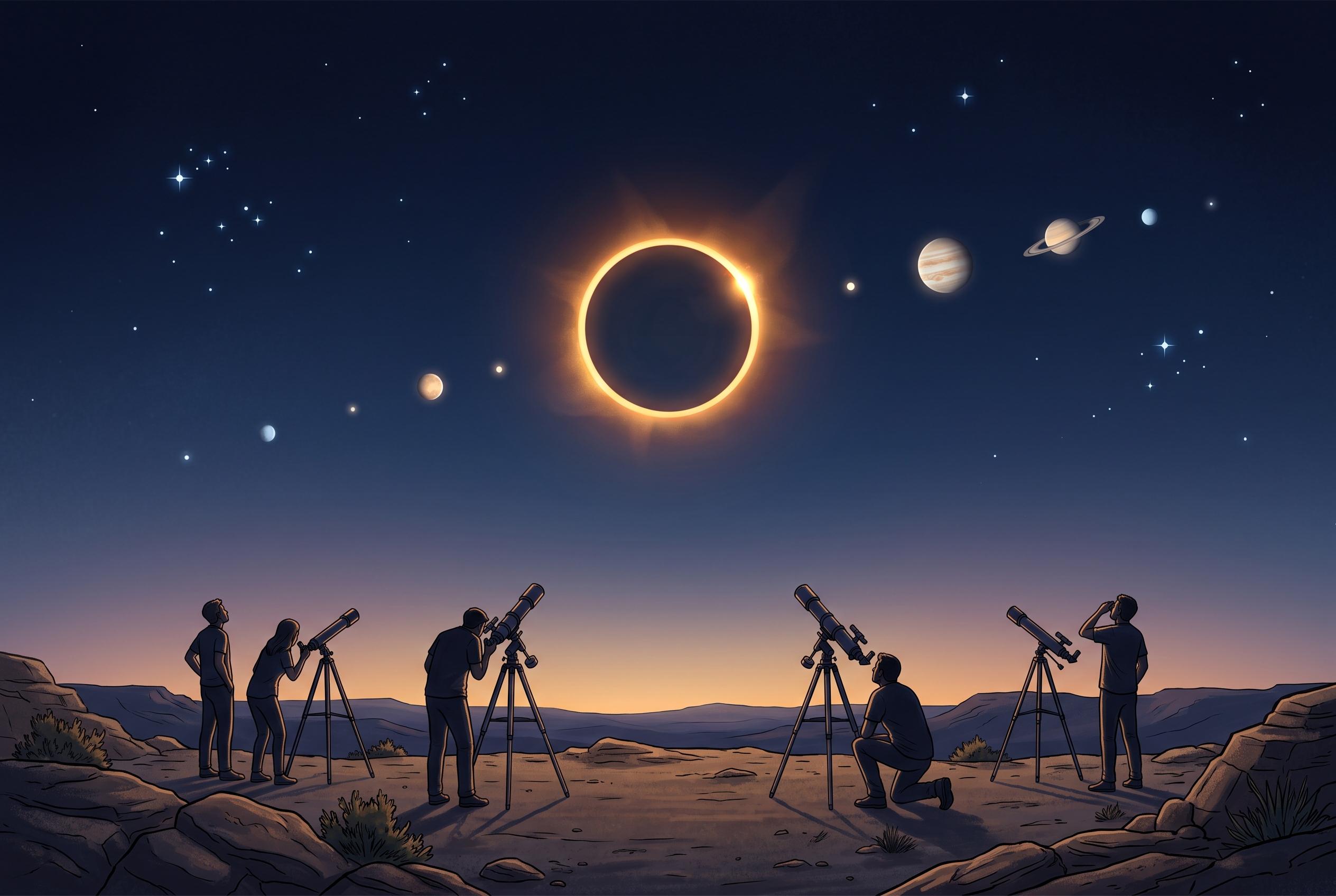

Skywatchers in February 2026 can look forward to a series of spectacular celestial events, including an annular solar eclipse, planetary alignments, and close encounters with bright stars and planets, offering prime opportunities for amateur astronomers to observe the night sky.
February 2026 is shaping up to be one of those months that gives skywatchers plenty to talk about. According to timeanddate.com, the line-up includes an annular solar eclipse, a planetary parade, and a series of close encounters between the Moon and bright stars and planets. For anyone who enjoys a bit of stargazing without needing a full kit of equipment, it is the kind of month that rewards simply looking up at the right moment.
The Moon sets much of the pace. Timeanddate.com says February begins with the Snow Moon on 1 February, before the lunar cycle moves through its familiar changes over the rest of the month. That makes the mid-month new Moon especially useful for anyone hoping to spot fainter stars and deeper-sky objects, since darker skies usually give the best view of the night sky’s less flashy residents.
The biggest celestial talking point lands on 17 February, when an annular solar eclipse takes place. NASA’s eclipse guide confirms that 2026 includes two solar eclipses and two lunar eclipses, with February’s event first on the calendar. Timeanddate.com says the eclipse will be visible mainly from a narrow route across remote parts of western Antarctica and the Davis Sea, with only a partial eclipse seen from some areas in southern Africa and the far south of South America. Space.com and Live Science both note that the event will be a classic “ring of fire” eclipse, with the Moon covering most, but not all, of the Sun.
The days around the eclipse bring several attractive sky meetings as well. Timeanddate.com highlights a close approach between Venus, the Moon and Mercury on 18 February, followed by a conjunction between Saturn and Mercury on 19 February. Later in the month, the Moon passes near Jupiter on 27 February, while 28 February is described as a planetary parade with six planets in view. That said, as the astronomy sites point out, “visible” does not always mean easy to spot; some of those planets sit low in the sky or shine more faintly than others, so a clear horizon matters.
For casual observers, the trick is keeping expectations realistic and timing the outing well. A dark location away from streetlights, a clear western horizon for the evening planets, and a few minutes for your eyes to adjust can make a surprising difference. And for the eclipse itself, the advice is straightforward: never look directly at the Sun without proper solar viewing protection. February’s sky may not hand out every spectacle in perfect conditions, but it does offer enough variety to make even a quick look outside feel like a small event.
Disclaimer: This content is intended for informational purposes only. Readers are advised to exercise their own judgement, conduct due diligence, or consult a qualified expert before acting on any information provided.