

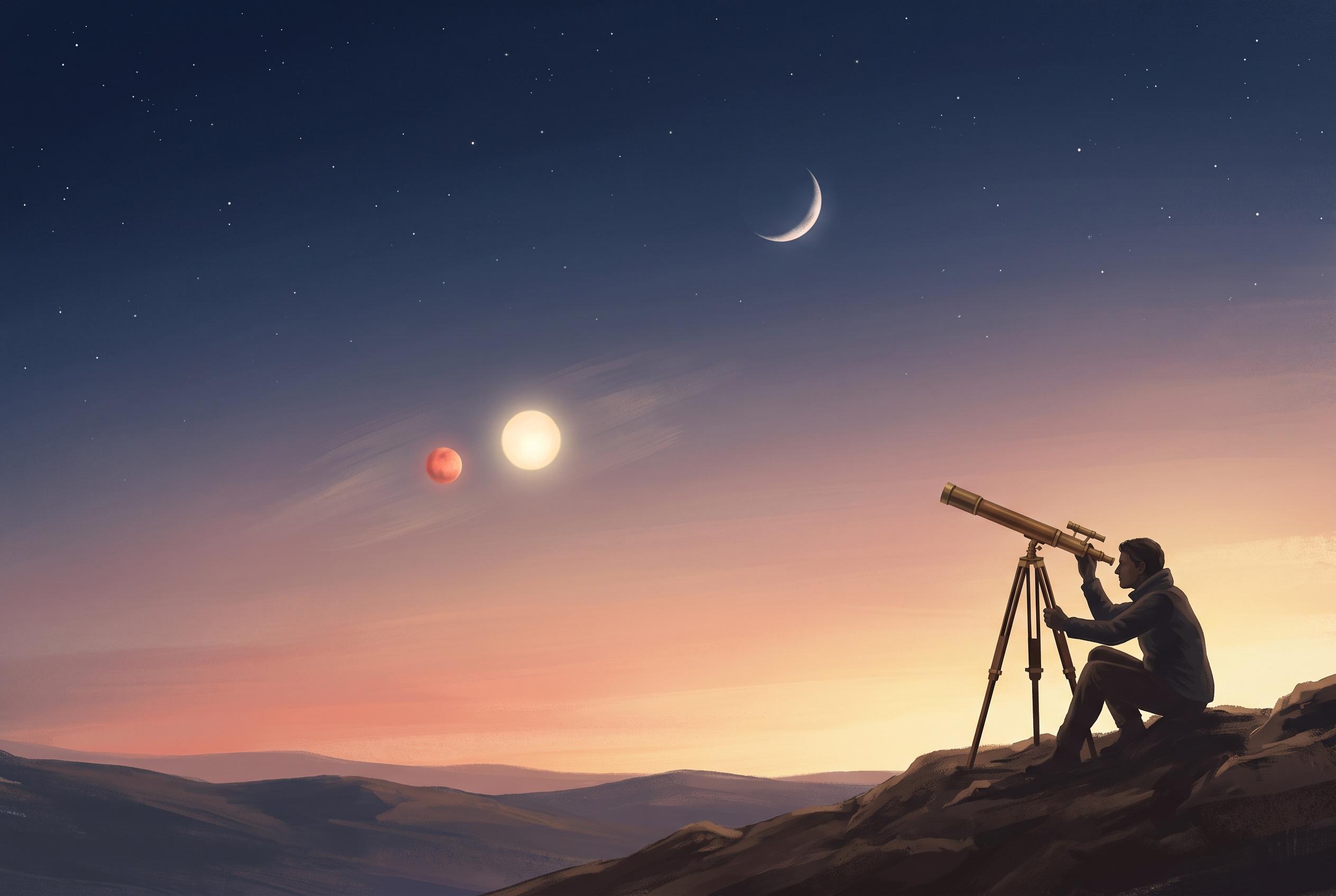

As Mars edges closer to Jupiter in the early mornings of October, skywatchers anticipate a spectacular pairing that culminates in a tight conjunction on 16 November, offering a rare celestial spectacle and astrological intrigue.
Mars is edging closer to Jupiter in the pre-dawn sky on 13 October 2026, setting up one of the season’s better morning-planet pairings. The two worlds are still separated by a noticeable stretch, but the gap is narrowing quickly, and skywatchers have a comfortable runway before their conjunction on 16 November. According to the observing notes from When the Curves Line Up, Jupiter is already the brighter beacon, hanging high in the east-south-east an hour before sunrise, while Mars sits above and to the right, creeping steadily towards it.
The view should be easy to enjoy with the naked eye, and binoculars will add extra charm by bringing Mars and the nearby Beehive star cluster into the same field for several mornings. That makes the approach a slow-burn event rather than a one-night spectacle: Mars is moving eastward in front of Cancer, while Jupiter continues its drift through Leo near Regulus, the Lion’s brightest star. HorizonLab says the best watching window is roughly between 4 a.m. and 6.30 a.m., depending on location, with the planets climbing higher as dawn approaches.
By early November, the pair will look dramatically tighter. Astrogoy’s calculations place the planets about 3°13′ apart on 8 November, with Mars closing at roughly 0.36° per day, before the closest visible approach on 16 November at 02:05 UT, when they will be about 1°12′ apart. The exact conjunction follows later that morning at 06:24 UT, when both planets line up at 25°53′ Leo. Forecast Bar gives a similar global reference time, peaking at 02:04 UTC, while noting that visibility will depend on darkness, horizon conditions and local weather.
For observers, the practical message is simple: keep checking the sky each clear morning and notice how quickly the geometry changes. What starts as a wide separation in mid-October turns into a neat pre-dawn close pairing by mid-November, with Mars the obvious mover in the story. CelestSky notes that the event should be especially well placed for northern observers, while binoculars will sharpen the view wherever the pair appears above a clear horizon.
There is also an astrological layer to the conjunction, with several astrology sites reading the meeting of Mars and Jupiter in Leo as a symbolically charged moment. Astrology for Aquarius and AstroSoleil both frame Mars as a planet of action and Jupiter as a force of expansion, suggesting the pairing may encourage boldness, confidence and big ambitions, while also warning against excess, arrogance or financial overreach. Those interpretations are not scientific forecasts, of course, but they do explain why this particular conjunction is likely to draw attention well beyond the astronomy crowd.
Disclaimer: This content is intended for informational purposes only. Readers are advised to exercise their own judgement, conduct due diligence, or consult a qualified expert before acting on any information provided.