

The Nine of Swords is tarot’s classic card of sleeplessness and dread, but its hanging blades offer a quieter message: fear can feel immediate without reflecting reality.
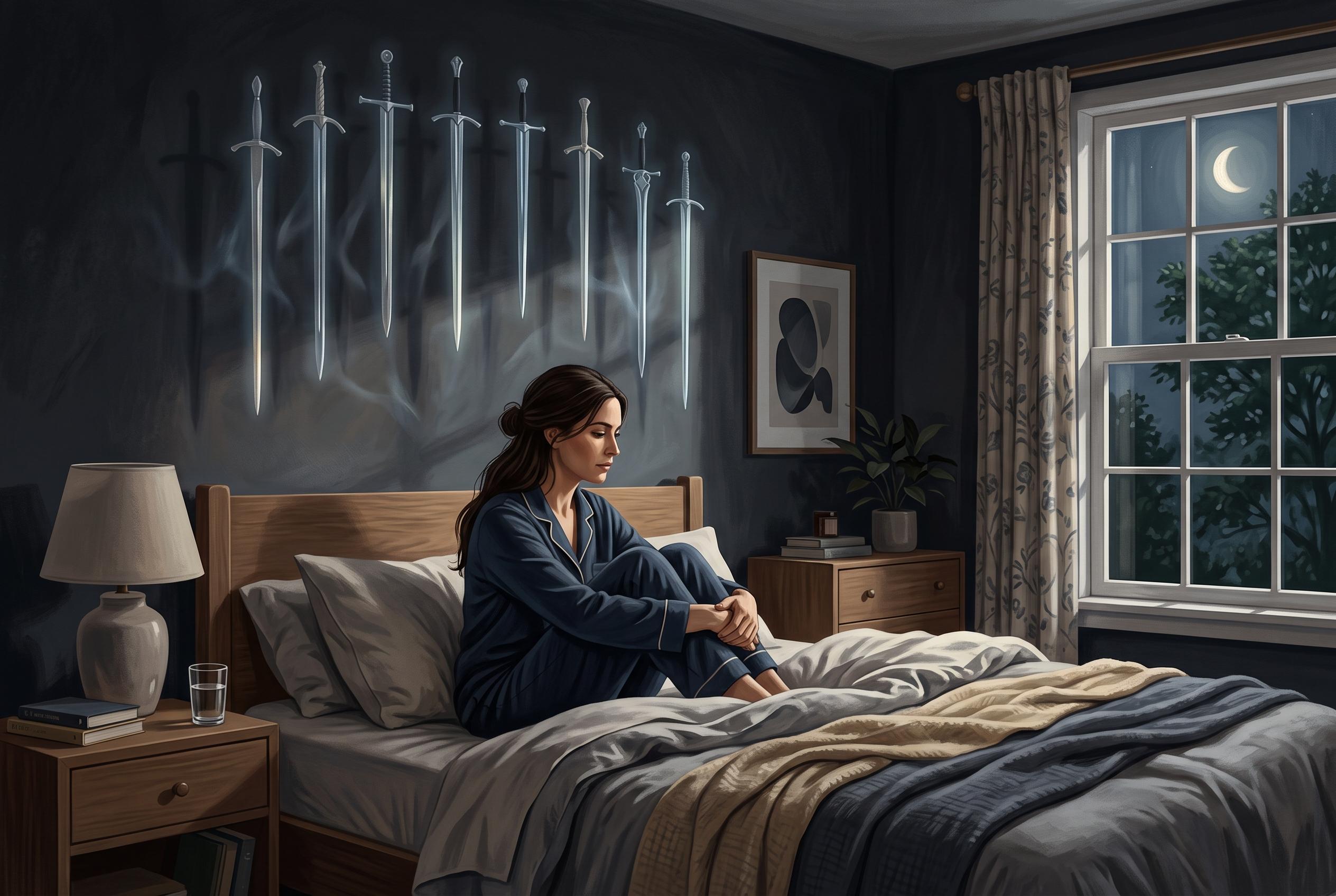
The Nine of Swords is one of tarot’s most recognisable anxiety cards, and for good reason. Its image is almost cinematic: someone bolt upright in bed, hands over the face, with a row of swords hanging behind them in the dark. The unsettling part, as several tarot guides note, is that the blades are not touching the figure at all. The threat feels immediate, but it is often the mind’s version of events rather than the events themselves.
That is why this card so often turns up around sleeplessness, dread, guilt and the familiar 3 a.m. spiral. Astrology.com, SimplyTarot and other card guides all frame it as a sign of mental distress, overthinking and fear that can feel larger than reality. In that sense, the Nine of Swords does not always point to danger so much as to the exhausting habit of living through a problem again and again in your head.
Paired with the Page of Swords, the message can be about checking, refreshing, scanning and searching for just one more clue. Paired with the Eight of Swords, it can look like a mental corner, where every option starts to feel blocked and the simplest next step seems impossible. With the Moon, the story often shifts towards filling in gaps with worst-case assumptions, as if uncertainty itself were proof that something is going wrong.
One of the kinder pairings is the Four of Swords. Where the Nine feels like an overactive mind, the Four suggests the opposite: pause, rest and stop wrestling with every thought at once. Tarot readers often treat that as a reminder that rest is not a reward for perfect problem-solving. Sometimes it is the thing that makes clear thinking possible again.
That is also the most useful way to read the Nine of Swords more broadly. It can describe a rough night, a guilty conscience, a fear that needs naming or a phase of life when the inner narrator has become far too loud. But the card is not a verdict. In most decks, the swords are still hanging on the wall, which is a useful little visual hint: the mind may be sounding the alarm, but the situation is not always as disastrous as it feels.
Disclaimer: This content is intended for informational purposes only. Readers are advised to exercise their own judgement, conduct due diligence, or consult a qualified expert before acting on any information provided.