

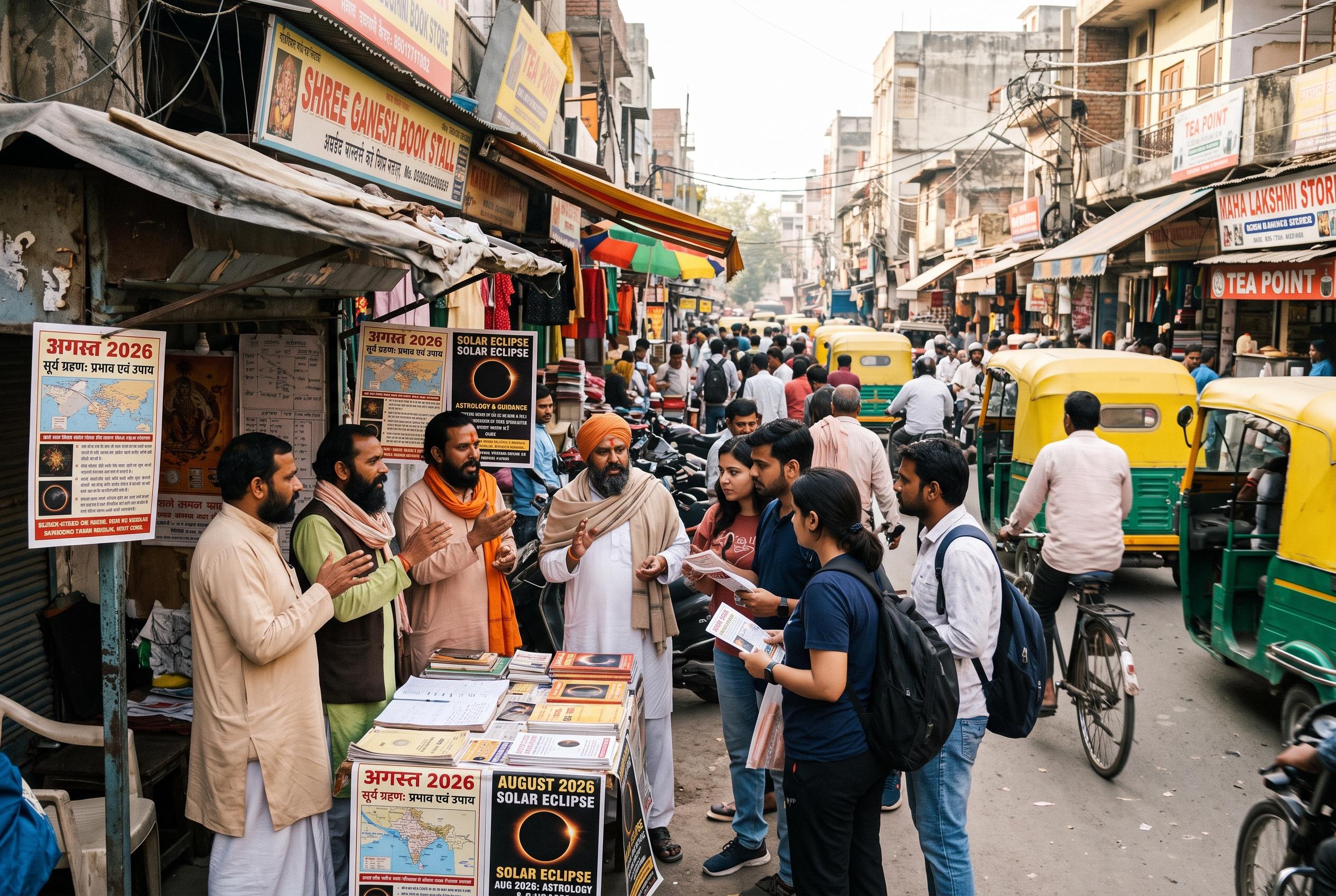

A total solar eclipse scheduled for 12 August 2026 will be visible mainly from Arctic regions and parts of Europe and North America, but it will not be observable from India. Despite this, Indian religious outlets continue to emphasise its spiritual importance and potential broader shifts, even in the absence of local visibility.
A total solar eclipse will take place on 12 August 2026, making it the year’s second major astronomical event and one that Indian religious outlets are describing as especially significant. According to Aaj Tak, the Moon will completely cover the Sun, briefly darkening parts of the Earth during the day, while astrologers are linking the event to broader shifts in nature and public affairs.
The eclipse’s path of totality is expected to cross the Arctic, Greenland, Iceland and northern Spain, with partial visibility across wider parts of Europe, North America and north-west Africa, according to the English-language eclipse listing on Wikipedia and regional timing details cited by other astrology sites. Reports on the event say the total phase will be observable in places such as Iceland and Spain, while most of Europe will see only a partial eclipse.
For India, the key point is that the eclipse will not be visible. Aaj Tak said it will occur during the night in Indian time, while astrological and astronomical timing pages note that the Sun will be below the horizon in Indian cities, including Kolkata. In practical terms, that means the eclipse will not be observed from India at all.
That distinction also matters for the traditional concept of Sutak Kaal. Aaj Tak says the usual 12-hour pre-eclipse observance does not apply in India when the eclipse is not visible there, and temples and daily worship can continue normally. Other astrology-focused publications make the same point, while also stressing that the eclipse is expected to fall in Leo in some interpretations and in Cancer in others, reflecting differences between astronomical and Vedic frameworks. Aaj Tak says the event is still regarded as spiritually important, and advises pregnant women and devotees to follow customary prayers and post-eclipse charity where they choose to observe the occasion.
Disclaimer: This content is intended for informational purposes only. Readers are advised to exercise their own judgement, conduct due diligence, or consult a qualified expert before acting on any information provided.