

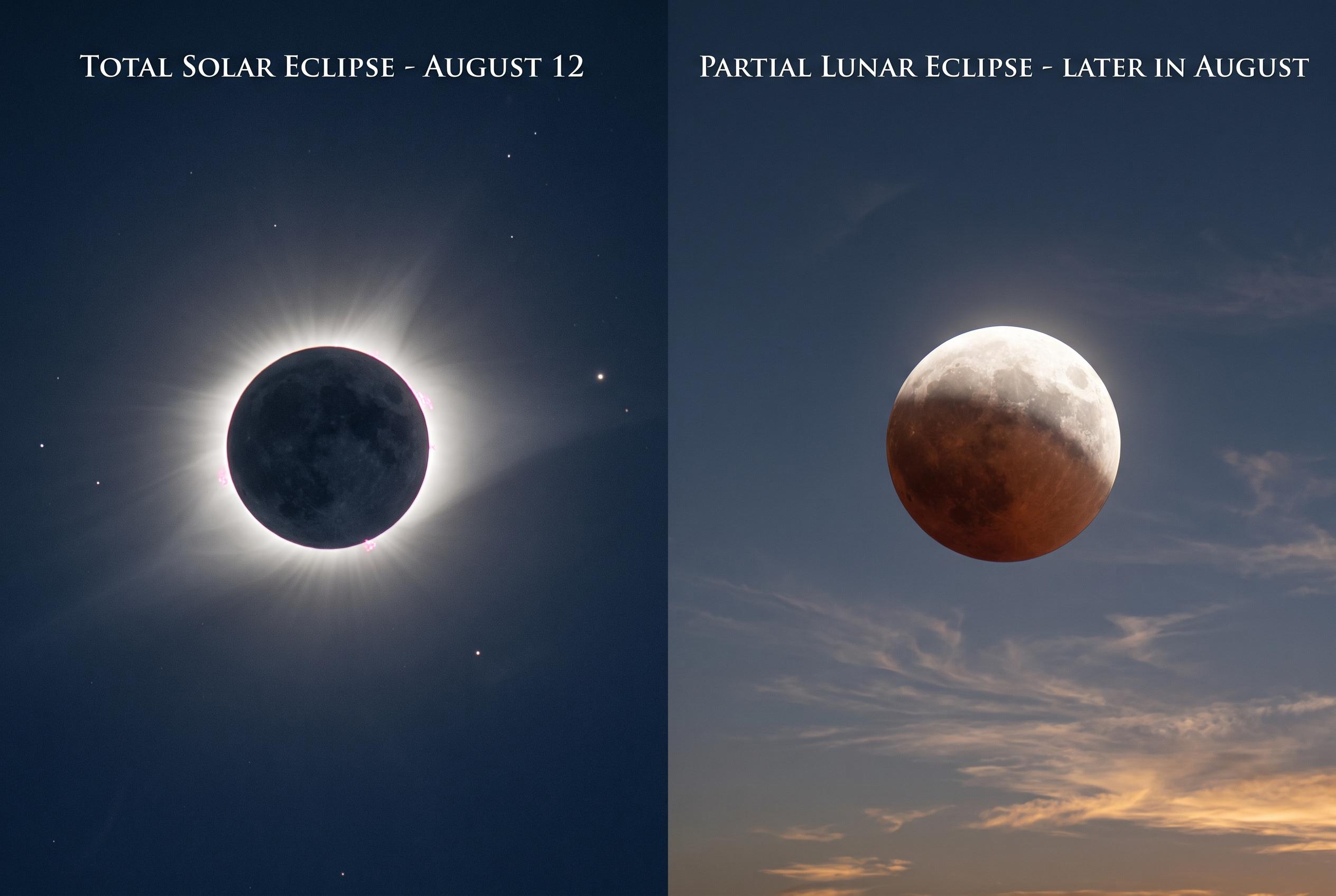

This August, sky-watchers are treated to a rare celestial event , a total solar eclipse on August 12 and a partial lunar eclipse later in the month, offering both dramatic and subtle views of the cosmos with rich astrological significance.
August brings a pair of sky-watchable moments that are a little different from one another but equally attention-grabbing: a total solar eclipse on August 12 and a partial lunar eclipse on August 27-28. The Nerd Stash says the two events offer a useful reminder that eclipses may share a name, but they do not behave in quite the same way.
The solar eclipse is the more dramatic of the two. According to Timeanddate, NASA and Space.com, it happens when the Moon slides directly between Earth and the Sun, briefly blocking the Sun’s light and turning day into something closer to dusk in places along the path of totality. Observers in Greenland, north-west Africa, Russia, Canada and parts of the northern United States are among those most likely to see it, although the view weakens considerably farther south. The key safety note is unchanged: never look straight at a solar eclipse without properly certified eclipse glasses.
Astrologically, the article frames the solar event as a Leo-season moment that could feel bold, creative and energising. That interpretation is in keeping with eclipse lore more broadly, which often treats a solar eclipse as a kind of reset button, a time when people may feel pushed to take stock, try something new or simply step into the spotlight a bit more willingly.
Later in the month comes the partial lunar eclipse, which works in a very different way. Timeanddate and NASA explain that the Sun, Earth and Moon line up so that Earth casts a shadow across only part of the Moon’s surface. Unlike a solar eclipse, this one is safe to watch with the naked eye. The Nerd Stash says the eclipse will be most visible in Greenland, the central and eastern United States, Canada, Mexico and parts of Latin America near the Atlantic, with some visibility also reaching north-eastern Africa.
In astrological terms, the lunar eclipse is described as a Pisces event, which the article connects with intuition, emotion and the sort of feelings people sometimes tuck away until they are ready to face them. Whether readers treat that as symbolic or simply enjoy the spectacle for what it is, the month’s double eclipse does offer a neat contrast: one event asks for protective glasses and a clear view of the Sun’s disappearance, while the other invites people to look up and watch Earth’s shadow quietly pass over the Moon.
Disclaimer: This content is intended for informational purposes only. Readers are advised to exercise their own judgement, conduct due diligence, or consult a qualified expert before acting on any information provided.