

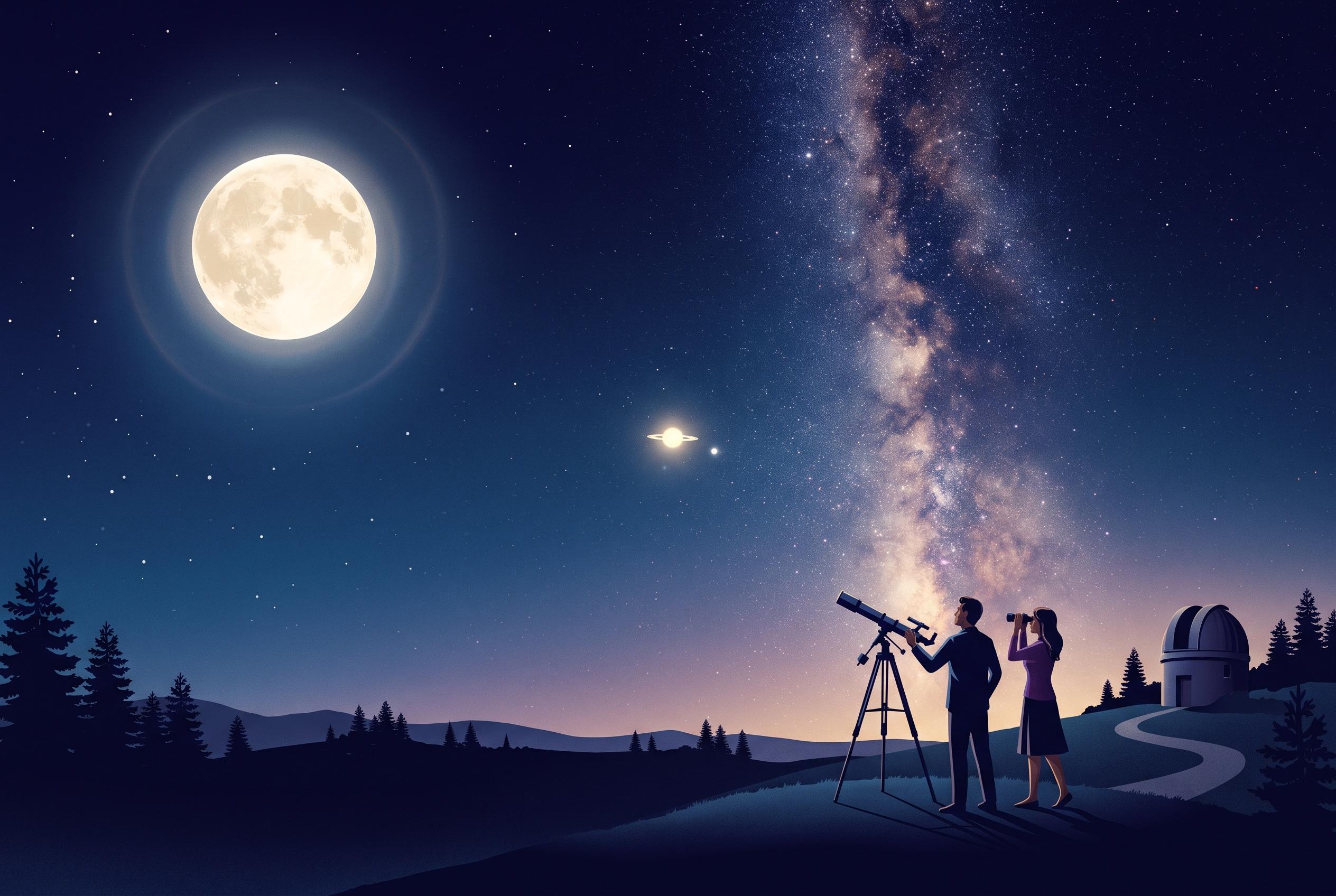

A vibrant September sky presents a blend of summer’s lingering Milky Way, a full Moon close to the equinox, planetary conjunctions, and the approach of Saturn’s opposition, offering stargazers a busy celestial calendar to explore throughout the month.
September’s night sky is doing that lovely in-between thing: summer’s Milky Way views are still hanging on, autumn’s longer nights are beginning to help, and the month finishes with a full moon rising in the same patch of sky as Saturn and faint Neptune. In Saudi Arabia, the Jeddah Astronomical Society’s Majed Abu Zahra has suggested a local seasonal nickname, the “Pomegranate Moon”, but the wider astronomy world is treating 26 September’s full moon as the Harvest Moon because it is the full moon closest to the September equinox. (science.nasa.gov)
For anyone setting an alarm, the first big run of events comes before dawn. National Geographic says the crescent Moon and Mars sit within roughly three degrees of each other on 6 and 7 September, visible around 3 a.m. local time above the eastern horizon, with Jupiter rising about 90 minutes later and Saturn still lingering in the south-west. By 8 September, the Moon shifts over to Jupiter. Timeanddate notes that some parts of eastern Russia will see an actual lunar occultation, with the Moon passing in front of Jupiter, while The Weather Network says observers elsewhere may need binoculars or a telescope because, in some locations, the event plays out in daylight rather than a properly dark sky. (nationalgeographic.com)
The easier crowd-pleaser is Venus, which is blazing low in the west after sunset all month. Astronomy.com says it stands about 10 degrees high 30 minutes after sunset on 1 September, then sinks lower as the month wears on, while the crescent Moon slides past on 13 and 14 September. Both Astronomy.com and NASA’s September skywatching guide flag 18 September as the moment Venus reaches peak brilliance for this evening showing, at magnitude -4.8, bright enough that National Geographic says it should still punch through the glow of built-up areas. If you have a perfectly flat western horizon, Mercury also makes a brief, awkward appearance low down, and Astronomy.com says the two planets become a very tricky pairing near month’s end. (astronomy.com)
Mid-month is a good time to go a bit beyond the obvious. NASA says that from 14 to 20 September the Moon can act as a signpost to Antares and the Teapot asterism in Sagittarius, and from a dark site you may still catch the Milky Way’s central regions before they slip out of prime evening view later in the year. The Planetary Society also highlights the Moon’s close pass by Antares on 17 September. Meanwhile, Timeanddate points out that Cassiopeia is climbing into an easy evening position in the Northern Hemisphere, making it a handy marker for anyone trying to get their bearings as the sky shifts from summer to autumn patterns. (science.nasa.gov)
If Saturn is your main target, September is really the warm-up lap before its early October opposition. The Planetary Society says it is rising shortly after sunset and staying up almost all night, while The Weather Network puts its rise time at around 9:30 p.m. local time at the start of the month, getting earlier night by night. Astronomy.com adds that Neptune reaches opposition on 25 September at magnitude 7.7, with Saturn sitting about 9.5 degrees to its east in Pisces, making the last week of the month especially good for people with binoculars or small telescopes. Saturn is bright enough for the naked eye; Neptune is not. (planetary.org)
There is one date wrinkle worth clearing up. NASA’s background material and Timeanddate both place the equinox at 00:05 UTC on 23 September, which means it falls on the evening of 22 September in parts of North America. Astronomy.com lists the moment as 8:05 p.m. on 22 September in US eastern time, so the difference is about time zone, not disagreement over the event itself. Timeanddate also says the equinox can coincide with a lift in aurora chances because of the Russell–McPherron effect, though that is more a nudge in the odds than a promise of a spectacular display. (science.nasa.gov)
Then comes the month’s finale. Timeanddate says the Harvest Moon reaches peak illumination at 16:49 UTC on 26 September, and NASA says it rises shortly after sunset near Saturn and Neptune. National Geographic notes that Saturn follows the Moon up and stays within about six degrees of it through the night, while Timeanddate lists a separate Moon-Saturn close approach on 27 September. So whether you like the Saudi suggestion of a “Pomegranate Moon” or stick with the traditional Harvest Moon label, the real selling point is simple: it turns up with good company. (timeanddate.com)
And if you want one extra challenge after the full moon glare has eased, Astronomy.com offers two nice bonus targets. Comet 10P/Tempel 2 is still around as a late-night object at about 8th magnitude, though it needs proper optics and darker skies than the headline events do. Then, on 29 September, Ganymede makes a transit across Jupiter that Astronomy.com says is visible across the US, beginning at 5:24 a.m. EDT for eastern observers. In other words, September is not just a one-night showpiece; it is a whole month of reasons to keep stepping outside and looking up. (astronomy.com)
Disclaimer: This content is intended for informational purposes only. Readers are advised to exercise their own judgement, conduct due diligence, or consult a qualified expert before acting on any information provided.