


Renowned filmmaker and spiritual thinker Alejandro Jodorowsky continues to challenge traditional views of tarot, emphasising its role as a tool for self-exploration and psychological healing rather than fortune-telling, in a new interview reflecting on decades of work and personal journey.
In a January 2026 interview, The Guardian (theguardian.com) caught Alejandro Jodorowsky still making the same mischievous, serious point he has been making about tarot for years: the cards are not a peephole into tomorrow, but a way of reading yourself now. He described his 78-card Marseille-based deck as “an alphabet of the soul” and, more plainly still, “a system for self-discovery and psychological healing”. That idea sits at the centre of The Way of Tarot, the book that has helped turn his approach from cult curiosity into a lasting school of thought.
The book itself is more substantial than the dreamy aura around it can suggest. The official publisher page at Simon & Schuster (simonandschuster.com) and the Google Books listing (books.google.com) identify The Way of Tarot: The Spiritual Teacher in the Cards as a 552-page volume by Jodorowsky and Marianne Costa, published on 17 November 2009 by Destiny Books. The publisher says Jodorowsky’s study of tarot began in the early 1950s and argues that the Marseille deck should be understood not as a parlour trick but as “a powerful instrument of self-knowledge” and “a representation of the structure of the soul”. Its imagery, the publisher adds, forms a temple or mandala, even a “nomadic cathedral”, language that makes clear this is a system he wants readers to inhabit rather than merely decode.
That is also where Costa’s role becomes impossible to ignore. The same publisher page (simonandschuster.com) says she has worked with Jodorowsky since 1997, co-teaching workshops on tarot and family tree-therapy. In La Vanguardia, the interviewer recalled Jodorowsky once describing Costa as the person who knew more about tarot than anyone else, before introducing her own book as the work of a “teacher of tarot teachers”. The paper (lavanguardia.com) also presented her view of tarot as a visual map of the psyche with more than 500 years of hand-to-hand transmission. For Costa, the cards are not there to pin down fate. She treats prediction as just one historical mutation among many, and says the only spread worth much is the one that speaks to the heart.
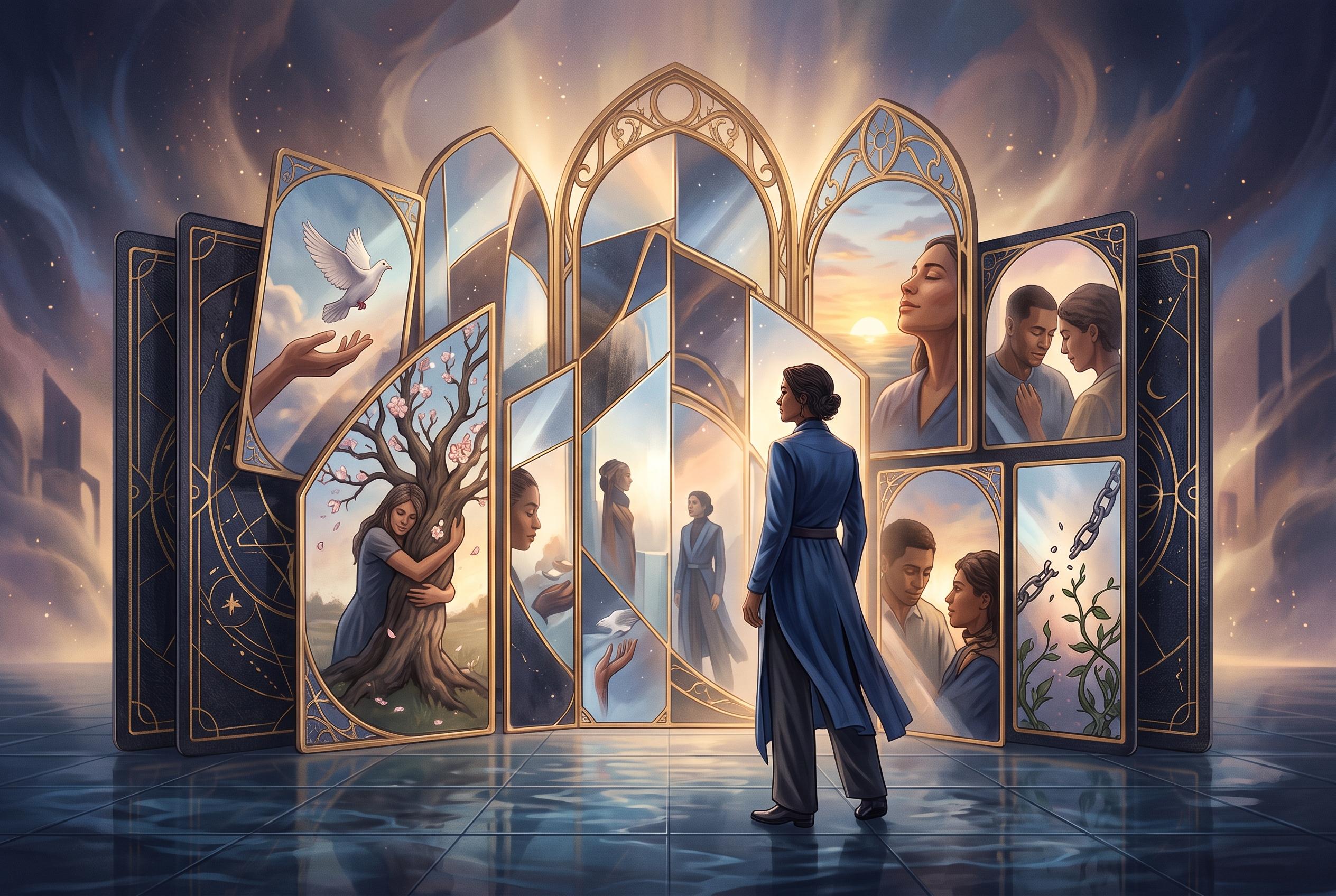
Jodorowsky has been striking that note in his own voice for a long time. In Film Comment’s 2012 interview, he boiled tarot down to a line that sounds almost too simple until you sit with it: “the tarot is what you see. It is a mirror.” Film Comment (filmcomment.com) also captured the performative, public side of his practice. When he is in Paris, he said, he goes every Wednesday to a café near his flat and reads for the first 20 or 25 people chosen by lottery, even though 150 or 200 may turn up. He called those requests “impossible things”, which is revealing in itself: people come wanting certainty, while he keeps redirecting them towards metaphor, imagination and self-recognition.
That urge to turn tarot into a mirror rather than a forecast is bound up with Jodorowsky’s own search for identity. In The Paris Review, he said his father concealed the family’s Jewishness, never signing his full name, Jaime Jodorowsky, and that he did not discover he was Jewish until he was about 13 or 14. He had no Bar Mitzvah and no Jewish education, he said, before later seeking himself through Zen, Kabbalah and the Torah. The Paris Review (theparisreview.org) quotes him linking tarot directly to that journey: the 22 Major Arcana cards, he said, matched the 22 letters of the Hebrew alphabet. In other words, the pack became part of a personal excavation before it ever became a published method.
The more recent biographical context makes the healing language feel less decorative and more hard-won. The Guardian (theguardian.com) reported that Jodorowsky was first introduced to the Tarot de Marseille by André Breton and later produced his own interpretation with designer Philippe Camoin. The same piece said the overdose death of his son Teo at 24 fed into his experiments with tarot-based psychotherapy. When Jodorowsky says he is “only trying to save my soul”, as he did in that interview, tarot stops sounding like an eccentric side project and starts looking like one thread in a much larger attempt to turn family trauma, art and symbolism into something survivable.
Costa pushes that idea in a slightly different, and sometimes lighter, direction. In La Vanguardia (lavanguardia.com) she said tarot began as a game in the Italian Renaissance, around 1450, and argued that any game lasting that long must be reflecting the human condition with unusual depth. She called reading tarot an artistic act and insisted that what matters is the language established “from heart to heart”. Even her refusal to become a guru fits the pattern. Asked for advice, she replied that tarot had taught her not to advise. That wariness is useful: it keeps the cards from hardening into doctrine.
Taken together, the book pages, interviews and later reflections make Jodorowsky and Costa’s position fairly clear. Their tarot is not anti-mystical exactly, but it is firmly anti-fatalistic. The official description of their “tarology” as a psychological approach that creates a mirror image of the personality comes from the publisher itself, while bibliographic listings repeat the same promise of self-realisation and healing. Simon & Schuster (simonandschuster.com) and Google Books (books.google.com) present the deck as a structured symbolic language rather than a bundle of predictions. That will not persuade every sceptic, nor does Costa seem desperate to convert anyone. But it does explain why this strand of tarot has endured: it offers not certainty, but a disciplined, image-rich way of paying attention.
Disclaimer: This content is intended for informational purposes only. Readers are advised to exercise their own judgement, conduct due diligence, or consult a qualified expert before acting on any information provided.