

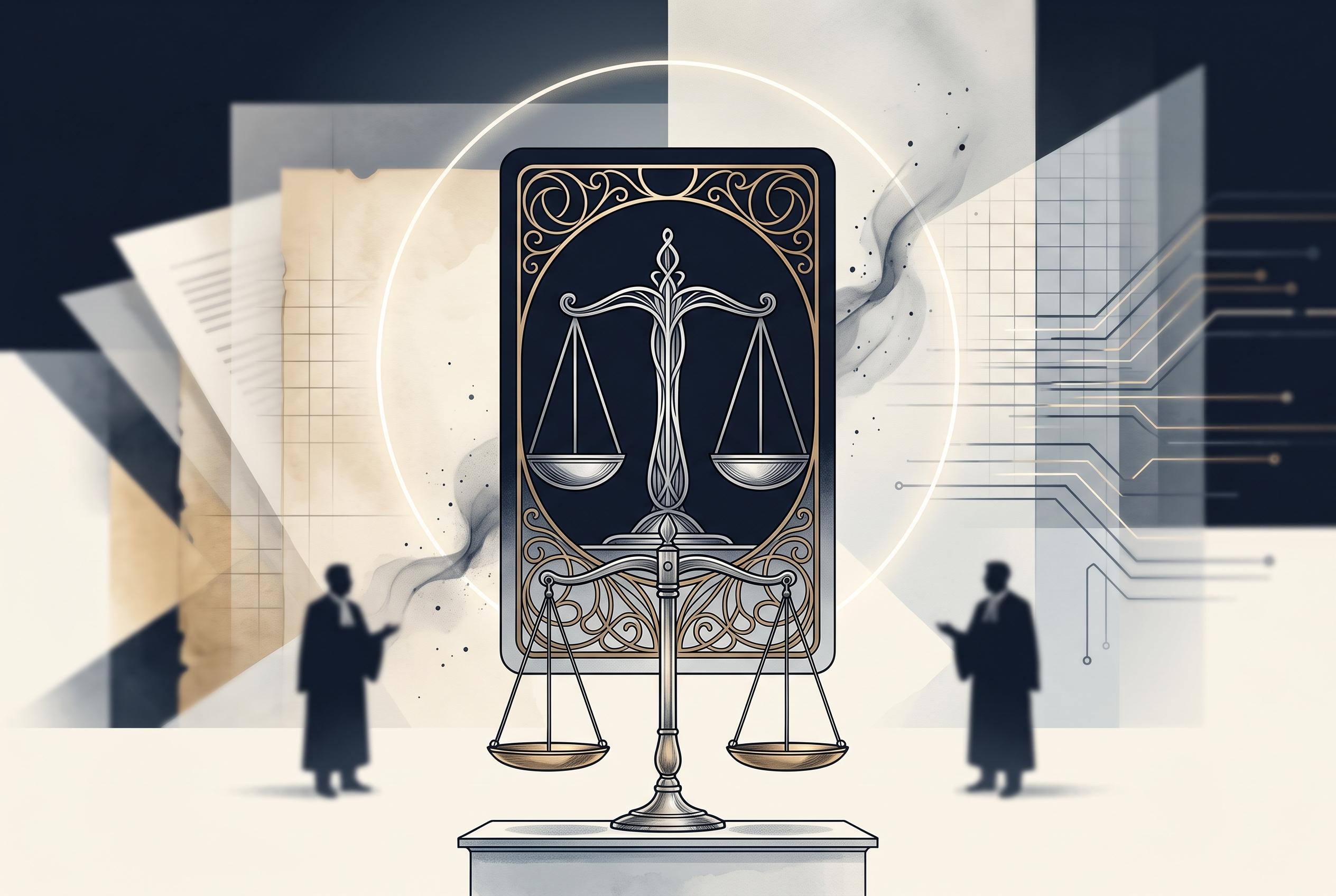

The Justice tarot card, often associated with fairness and balance, reveals a deeper message about consequences and the importance of clarity amid evolving interpretations across different traditions.
Justice is one of those tarot cards that looks simple until it is not. The image is neat: scales, sword, a seated figure who seems to know exactly where the paperwork is. But the deeper message is less about tidy fairness and more about consequence. According to Astrology.com, Tarot.com, Celeste Tarot, TarotWise and PullTarot, Justice is about truth, balance, accountability and the law of cause and effect.
In practice, that means the card often shows up when something needs a proper review. Feelings matter, but so do facts. Intentions matter, but so do outcomes. The card can point to agreements, legal questions, ethical decisions or any situation where a clearer standard is overdue. In love readings, the emphasis is usually on honesty and reciprocity; in work or money matters, it often nudges you to read the small print and keep your records straight.
The card’s symbolism does a lot of the heavy lifting. The sword suggests discernment and a decision that cannot be postponed forever, while the scales ask for proportion rather than theatrics. Several major tarot sites note that Justice is commonly linked with Libra and Air, which fits the card’s cool, measured feel. In the Rider–Waite–Smith style, the figure sits between pillars, reinforcing the sense that judgement is happening within a wider structure, not in a vacuum.
There is also a neat historical wrinkle: Justice appears as VIII in some traditions and XI in others. That shift reflects different esoteric systems rather than a simple mistake. The Marseille line keeps Justice at VIII, while the Rider–Waite–Smith and Golden Dawn traditions place it at XI and connect it with Libra. Either way, the core idea stays the same: balance is not passive, and fairness usually requires action.
If Justice feels a little stern, that is fair enough. It is not the card of “everything will sort itself out”. It is more the card of “what is actually true here, and what would be the most proportionate response?” In that sense, it can be strangely reassuring. Not because it promises an easy outcome, but because it asks for clarity, and clarity is often where things finally start to move.
Disclaimer: This content is intended for informational purposes only. Readers are advised to exercise their own judgement, conduct due diligence, or consult a qualified expert before acting on any information provided.